
It was a good first week back at school, and I am glad to be back in the rhythm of a regular schedule. Technology and Treasury yields drew most of the attention in markets this week, and I came up with a couple of research ideas today that I spent more time digging into.
Weekly Recap
Technology led a volatile but constructive week for US equities. QQQ gained 3.2% to close at $744.50, SPY rose 1.1% to $771.35, and IWM fell 0.7% to $281.97, so the advance was narrow and led by large cap technology. Wednesday was the sharpest reversal, with QQQ down 0.8% and IWM down 1.8% as the 5-year yield touched 5% for the first time since 2007. Meta Platforms (NASDAQ: META) jumped nearly 13% on the release of its Muse AI agent, Microsoft (NASDAQ: MSFT) gained about 4%, and Akamai Technologies (NASDAQ: AKAM) rose 3% on Friday after announcing a multiyear deal with Anthropic. Costco (NASDAQ: COST) reported fiscal Q4 on Thursday and beat on both lines, with EPS of $6.75 against roughly $6.55 expected and revenue of $95.7B against $94.9B. The US and Canada renewal rate rose to 92.3%, which answered the question about the fee increase. Gross margin fell 11bps to 11.02%, and EPS included a $0.15 benefit from tariff refunds. The stock was up about 2.5% on Friday morning.
Rates were the bigger story. The 10-year Treasury yield touched 5.228%, its highest level since 2007, and closed Friday at 5.18%, while the 30-year settled at 5.5%. A strong PMI reading and hawkish Fed comments pushed yields higher, and fed funds futures showed roughly a 64% to 66% chance of an October hike. Oil moved the other way, with Brent at $104.32 and WTI at $92.41 on Friday on hopes that the Strait of Hormuz could reopen.
The Trump and Xi summit in Washington, held from Wednesday to Friday, was the week's main geopolitical event and it delivered little. The one concrete result was a two-month extension of the trade truce, which was due to expire in November, to January 10. The two sides also agreed to a working group on agricultural trade, but they did not agree on AI, and the other trade announcements were limited. That leaves tariffs and critical minerals open and keeps the deadline risk alive into the new year. Equities still closed higher on Friday, which suggests the market saw avoiding escalation as enough. August Durable Goods Orders were virtually unchanged at $338.6B against expectations for a decline. On Sunday night, President Trump rejected Iran's latest proposal to reopen the Strait, and equity futures pointed lower.
What I'm Watching Next Week
Rates stay in focus, with the 10-year near 5.2% and futures pricing a real chance of an October hike. Wednesday's August Core PCE is expected at 3.4% year over year after 3.3%, and a hotter print would strengthen the case for a hike. Friday's September jobs report is the main event, with consensus at 100K jobs after 162K and unemployment at 4.2%. A strong number would push yields higher, while a weak one would reopen the debate. Thursday's ISM Manufacturing is expected at 54.8 after 54.6, and another strong reading would confirm the growth that has been lifting yields. Globally, the Reserve Bank of Australia is expected to hike 25bps to 4.60% on Tuesday, which would add to the global tightening theme. Euro area flash CPI on Friday is expected at 3.5% against 3.2%, and a hotter reading would raise pressure on the ECB to tighten. Oil matters too, since Sunday's OPEC and non-OPEC meeting could shift supply expectations while the Strait of Hormuz remains unresolved.
On earnings, the one I am most focused on is Micron (NASDAQ: MU), which reports Wednesday after the close with consensus at about $31.50 in EPS and $51B in revenue. A beat is largely expected, so guidance and comments on HBM pricing will decide the move. Nike (NYSE: NKE) reports Thursday after the close with consensus near $0.44 in EPS and $11.3B in revenue. The focus is Greater China and whether gross margin starts to expand as promised, with the stock near a 12-year low around $36. Carnival (NYSE: CCL) reports Tuesday before the open, and its fuel costs and bookings give a read on the consumer with oil above $90.
Research
Every morning the options market quotes how far SPY is expected to move, and every day SPY moves however far it likes. Those two numbers rarely match, and the gap leans one way. Over about 860 sessions since April 2023, using the one-day volatility index on the S&P 500 (VIX1D) as the implied side, implied volatility overstated the realized move by about 9% on average. SPY closed inside the implied one standard deviation range on 75% of sessions, against roughly 68% if options were fairly priced. That gap is called the volatility risk premium, and the simplest way to understand it is as the cost of insurance.
An insurer charges more than the average claim because the claims all arrive at once. Options work the same way. On most days the seller keeps a small premium, and on a handful of days the buyer is paid back many times over. The chart below shows both sides. The blue line is the move implied at the open, the orange dots are what SPY actually did, and the red bars at the bottom are where the insurance paid out. In April 2025, VIX1D opened near 65 on the day a 90 day tariff pause was announced mid-session. That priced a move of about 4%, and SPY moved more than 10% by the close. The premium collected on quiet days is what buyers pay to be covered on days like that.
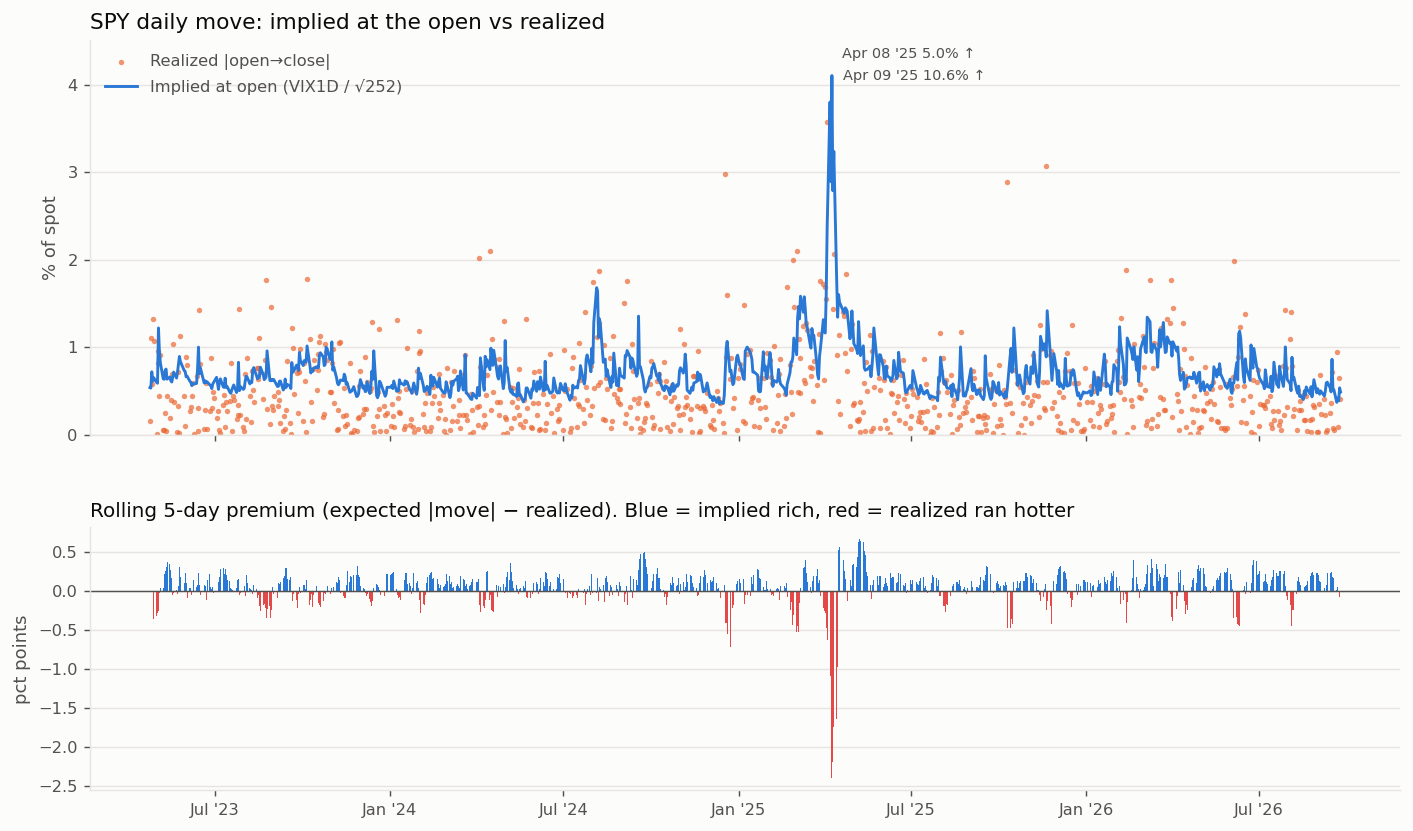
SPY daily move, implied at the open versus realized, April 2023 to September 2026
The insurance is not priced evenly either. In US equities, a put the same distance below spot almost always costs more than a call the same distance above it. That tilt is called skew, and it comes from who is buying. Most investors already own stocks, so the risk they want to insure against is a fall, and falls tend to arrive faster than rallies. Demand for puts pushes their price up, so the downside tail carries most of the premium.
Bitcoin shows what happens when the fear changes direction. In late August, bitcoin ran from about $64K to above $80K in roughly a week. Call skew on IBIT, the largest bitcoin ETF, rose by the most over three days since at least January 2025, and short dated calls traded richer than puts. Traders were not insuring against a loss. They were paying up to avoid missing the move. Within a few days, short dated skew had swung back toward puts as holders started protecting their gains. Skew shows which tail the market fears more, and it can flip quickly.
The implication is that implied volatility is not a pure forecast. It is a forecast plus the price of fear, and that price is highest wherever the crowd is most worried. That is why selling options can pay over time, but only for someone who can survive the days the insurance pays out. Buying it only makes sense when the insurance is priced below the risk. Before reading an option price as a prediction, ask which tail is being paid for and whether that fear is justified.
Personal
I have written about building good habits before. This week I have been thinking about breaking bad ones. Some habits can be changed with attention, like sleep, preparation and reviewing trades. Others come from mood rather than process, like closing a winner too early or holding a loser because I do not want to admit I was wrong. Knowing about them does not make them disappear. They show up on the days I am tired or overconfident, which are usually the days they cost the most.
So now I ask whether a habit is something I can change, or something I should take out of my hands. When it is the second, I write it into code. A computer does not have a bad morning, and it only changes when the evidence does. That is why I keep improving my system.
My judgment still matters, though. I decide what is worth testing and when a result does not make sense. The way I see it, it is part human and part machine, almost like a cyborg. I bring the ideas, and the code brings the consistency I cannot guarantee from myself every day.
Disclaimer: Everything here reflects my own opinions and is shared for informational purposes only. It is not financial advice, and nothing in this report is a recommendation to buy or sell any security.